
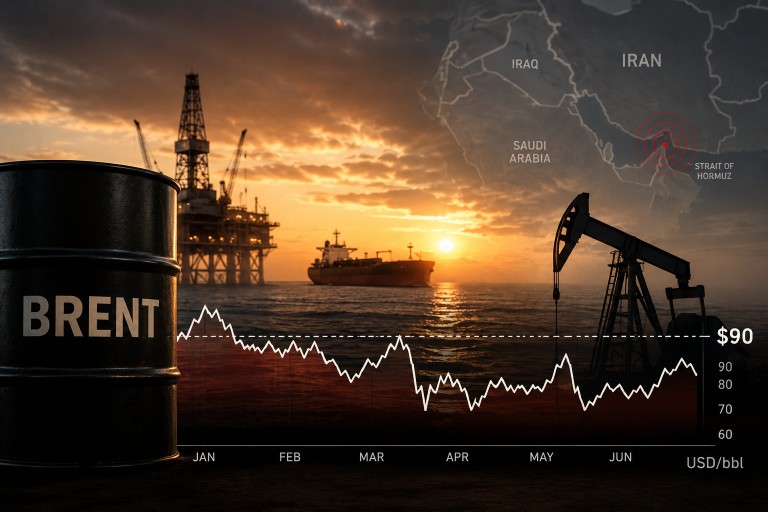
Despite experiencing its most significant weekly rise since April, Brent crude prices may need a more extended disruption in the Strait of Hormuz or clearer indications of global supply constraints to surpass the $90 per barrel threshold. On Friday, the global benchmark hovered near $85, poised for an 11% weekly uptick, while West Texas Intermediate, the U.S. benchmark, neared $80. This surge in oil prices follows renewed military tensions between the United States and Iran, which have disrupted supply channels in the Middle East and slowed tanker traffic through the crucial Strait of Hormuz, a vital passage for approximately 20% of the world’s oil flows.
Even as the conflict has spread across the region and the movement of tankers through Hormuz has slowed considerably, Brent crude has found it challenging to break past this week’s high of $87.55 per barrel. Analysts suggest that the market’s belief in the potential for diplomatic solutions is restraining further price increases. Traders are keenly observing whether a sharp decline in global oil inventories will occur and if the disruption in Hormuz will extend further into the future.
The oil market’s relative stability persists despite increasing military confrontations. Brent crude has been trading within a narrow band recently, signaling that investors might be anticipating a de-escalation in tensions rather than a further escalation. The Strait of Hormuz continues to be a focal point of concern for energy markets. While tanker traffic has been reduced, exporters are progressively exploring alternative routes to lessen their reliance on this strategic passage.
The repercussions of the situation extend beyond crude oil alone. In the United States, refining margins have risen due to tightening diesel and gasoline supplies, and European fuel markets are also beginning to exhibit signs of distress. The situation is exacerbated by a reduction in Russian fuel exports, which has added additional strain to global energy supplies.
As events unfold, market observers are concentrating on two critical factors: whether oil inventories will deplete enough to indicate a supply shortage, and whether diplomatic efforts will falter, resulting in a prolonged disruption in the Gulf. Until one of these scenarios comes to fruition, analysts predict that Brent crude is likely to stay below the $90-per-barrel mark, despite the elevated geopolitical risks.