
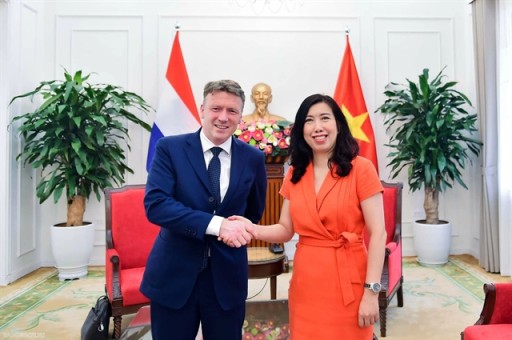
In Hanoi, Vietnam and the Netherlands convened for their second deputy minister-level political consultation, underscoring a shared desire to broaden collaboration across various domains. Co-chaired by Vietnamese Deputy Foreign Minister Lê Thị Thu Hằng and Dutch Deputy Foreign Minister Marcel de Vink, the discussions focused on evaluating the progress of bilateral relations. Both nations expressed satisfaction with the ongoing enhancement of diplomatic exchanges, economic ties, and their cooperative efforts in regional and international arenas.
Vietnam emphasized its strategic aspirations, aiming to transition into an upper-middle-income country by 2030 and achieving the status of a developed, high-income nation by 2045. To realize these ambitions, Vietnam intends to harness science and technology, innovation, and digital transformation as pivotal elements for sustainable development. The Vietnamese representatives advocated for more robust implementation of their Comprehensive Partnership with the Netherlands and existing strategic cooperation agreements. They also highlighted the potential for increased collaboration in areas such as trade, investment, sustainable agriculture, climate adaptation, green transition, digital transformation, and innovation.
The Vietnamese delegation urged support for ratifying the EU–Vietnam Investment Protection Agreement and sought the lifting of trade barriers affecting seafood exports. Meanwhile, the Netherlands reiterated its dedication to fortifying its partnership with Vietnam, considering the Southeast Asian nation a vital and reliable ally in the Asia-Pacific realm. Dutch officials showed eagerness to send more extensive business delegations to Vietnam and expand joint ventures in high-tech industries, semiconductors, artificial intelligence, scientific research, and workforce development.
Both countries committed to strengthening cooperation in security, defense, justice, culture, tourism, and fostering people-to-people connections. They also encouraged tighter networking between local governments and businesses. On pressing regional and global matters, the two sides reaffirmed their support for multilateralism, free trade, and the peaceful settlement of disputes based on international law. Additionally, they highlighted the significance of maintaining peace, stability, and ensuring freedom of navigation and overflight, particularly under the auspices of the 1982 United Nations Convention on the Law of the Sea.