
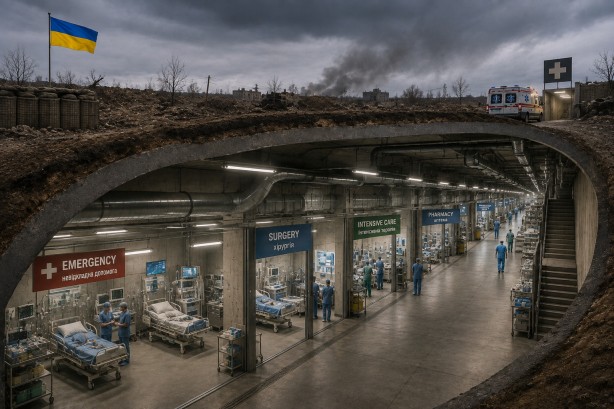
Plans to construct a significant underground hospital in Ukraine, designed to offer emergency medical care while safeguarding patients and healthcare workers from drone and artillery assaults, have been unveiled by a Dutch foundation. Positioned near the front line, this facility is set to become the largest of its kind in the country. Spanning approximately 600 square meters and situated about 8 meters below the surface, the hospital will be fortified with reinforced concrete to endure heavy bombardments. It will house six operating rooms dedicated to urgent trauma care, addressing needs such as shrapnel surgeries and blood transfusions.
Instead of operating as a conventional long-term hospital, this project is intended to function as an underground stabilization center. Its primary role will be to provide immediate surgical intervention for severely injured soldiers, stabilizing them for further transfer to hospitals located at a safer distance from the front lines. To ensure its security, the exact location of the hospital remains undisclosed. With construction preparations already in progress, the facility is slated to commence operations in February 2027.
This initiative was commissioned by Ukraine’s Military Medical Service and is supported by a Norwegian healthcare foundation. The comprehensive cost of constructing the underground complex is projected to be €2 million. Additional expenses, covering medical equipment, supplies, and armored evacuation vehicles, are estimated at €500,000. Thus, the total cost of the project is anticipated to reach €2.5 million. Currently, around €750,000 has been raised, and efforts are underway to secure the remaining €1.75 million required.
The increasing use of drones in combat zones has escalated the risks associated with traditional evacuation methods, underscoring the necessity for secure medical facilities close to areas of conflict. Project organizers emphasize the importance of this underground hospital in providing protected, immediate care, thereby enhancing the safety and effectiveness of medical responses in these volatile regions.