
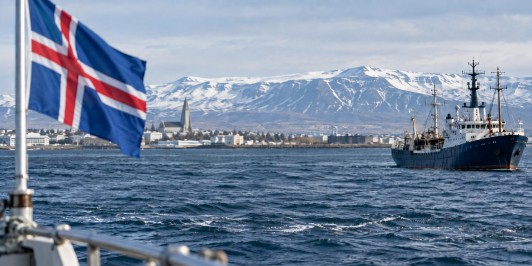
Iceland is gearing up to introduce a legislative measure that aims to permanently ban commercial whaling, a significant shift that would leave Japan and Norway as the sole nations continuing this practice. The Icelandic government plans to present the proposed bill to parliament by February, marking a potential end to a long-standing debate that has seen opposition from both animal welfare advocates and conservation organizations.
The focus of Iceland’s whaling industry has predominantly been on fin whales, which are recognized as a vulnerable species. During this year’s hunting season, which spans from June to September, the industry has operated under a government-sanctioned quota, resulting in the capture of numerous fin whales. The legislation to ban commercial whaling has garnered support from animal welfare groups, who argue against the practice due to ethical, environmental, and conservation-related concerns.
Despite an international moratorium established in 1986 to protect whale populations, Iceland resumed commercial whaling in 2006. This places them alongside Norway, which recommenced its commercial whaling activities in 1993, and Japan, which in 2019 exited the International Whaling Commission to resume whaling within its territorial waters and exclusive economic zone. If Iceland’s parliament approves the new legislation, it would signify a major shift, leaving Japan and Norway as the last nations engaged in commercial whaling.
The international moratorium on commercial whaling does, however, allow for exceptions. Indigenous communities in specific regions, such as parts of Greenland and Alaska, are permitted to hunt whales as part of their cultural, traditional, and nutritional practices. This distinction acknowledges the different contexts in which whale hunting occurs, contrasting with the commercial motivations seen in the nations continuing the practice.