
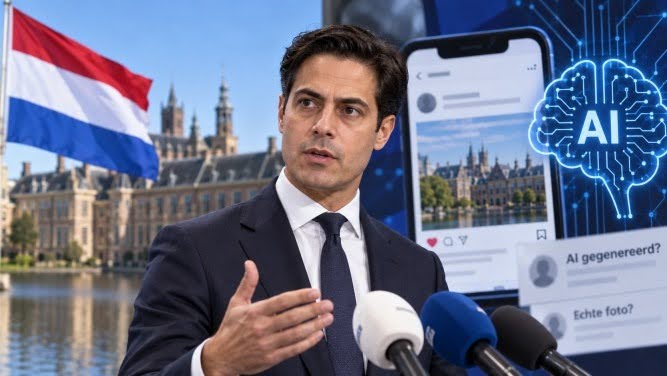
Rob Jetten, the Dutch Prime Minister, along with his political party D66, has come under scrutiny for utilizing artificial intelligence to craft numerous social media posts, stirring debates over their authenticity and the potential impact on public trust. An examination of 1,812 social media entries on platforms like X, Instagram, Facebook, and LinkedIn, dating back to 2021, revealed that at least 232 of these posts were generated by AI chatbots. Of these, 68 posts were traced back to Jetten’s personal accounts, while the remaining 164 were linked to the D66 party.
The reliance on AI technology saw a marked increase following the collapse of the Schoof I Cabinet in June 2025, with AI-generated content accounting for roughly 30% of posts from Jetten and D66 thereafter. This technological approach was not limited to social media; AI assistance was also employed in creating parts of Jetten’s book, “Hoe het wél kan,” and in scripting portions of three D66 campaign videos. The AI-generated posts have attracted significant attention, particularly those addressing delicate topics such as the war in Ukraine, the commemoration of the MH17 disaster, and the governmental apology to the Moluccan community.
Despite acknowledging the use of AI, D66 insists that all content undergoes thorough review and refinement by the party’s staff. They further maintain that posts on Jetten’s personal accounts are inspired by his own input and are either approved or edited by him. However, the practice has sparked a conversation about the authenticity of political communication, with experts expressing concern over the potential erosion of credibility when AI-generated material is presented as personal communication.
Claes de Vreese, a professor at the University of Amsterdam, has voiced apprehensions regarding this issue, suggesting that AI-crafted language could blur the lines between a politician’s genuine perspectives and computer-generated messages. This controversy is amplifying discussions on transparency and the ethical implications of employing AI in political discourse, especially when individuals expect official social media narratives to genuinely reflect the personal beliefs and expressions of elected officials.