
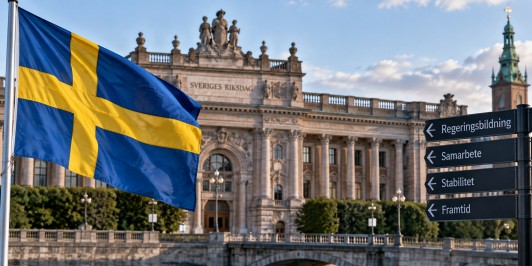
In Sweden, political parties have embarked on coalition talks after an intensely competitive parliamentary election. The centre-left faction, spearheaded by the Social Democrats, currently holds a slender advantage with 176 seats, compared to the 173 seats secured by the right-leaning bloc. As the country awaits the final tally — incorporating overseas ballots expected later this week — the process of forming a new government hangs in the balance.
Social Democrat leader, Magdalena Andersson, has kickstarted discussions for potential coalition formations, aiming to return to power. Meanwhile, outgoing Prime Minister Ulf Kristersson, along with his centre-right allies, is also exploring avenues to maintain their hold on government. The tight margin between the blocs has introduced a level of uncertainty regarding the forthcoming government’s makeup. A key player in these negotiations is the Centre Party, which is anticipated to be pivotal in determining coalition outcomes, though its relationship with the Left Party remains fraught with disagreements.
The Centre Party has articulated its desire for a stable government oriented towards the centre-right, explicitly ruling out partnerships with what it deems to be fringe political entities. On the other side of the political spectrum, several left-wing parties are advocating for a governmental shift and cautioning against the risks of a prolonged political deadlock that could necessitate another election. Notably, the Sweden Democrats, who had been supporters of the outgoing right-wing government, have seen a drop in their support, reducing their likelihood of participating in the next government. Nevertheless, the party’s stances on immigration, integration, and crime continue to impact Sweden’s broader political discourse.
Kristersson remains non-committal as he waits for the definitive election results, with the Moderates and their allies facing the daunting task of securing a viable parliamentary majority. Both the Liberals and Christian Democrats have dismissed the possibility of collaborating with the Social Democrats. The newly elected parliament is set to convene on September 28, with the earliest opportunity to vote on a new prime minister slated for the following day. Should efforts to elect a prime minister repeatedly fall short, Sweden may face the prospect of another election.
The timeline for coalition negotiations remains uncertain, potentially spanning weeks or months. Historical precedent suggests this could be a lengthy process; it took 37 days to form a government following the 2022 election, while the aftermath of the 2018 election saw negotiations dragging on for 134 days. With neither political faction possessing a decisive majority, the roles of the Centre and Left parties are crucial in shaping who will ultimately govern Sweden next.